Burst Pipe and Appliance Water Damage
Bottom line: shut off the water first, then work out where it went. A failed pipe or appliance puts clean water into a house, sometimes slowly for weeks, sometimes fast enough to cover a floor in minutes. Either way it soaks into walls, under cabinets, through floors and, in many Kitsap houses, down into a crawlspace or basement. The pipe or appliance itself is a separate repair. The water damage it left behind is what a restoration company dries and rebuilds.
Shut It Off
- Close the fixture's own valve if it has one: toilets, sinks, washers and dishwashers usually do.
- Close the main if you can't isolate it. In older Bremerton houses the main is often in the basement or crawlspace; in newer homes, often in the garage or near the water heater.
- For a water heater, turn the breaker off (electric) or the gas control to off, then close the cold-water valve on top.
- Cut power to any wet outlets or appliances.
- Open a faucet on the lowest floor to drain the lines once the main is shut.
Find the main now, before you need it. Ten minutes on a dry day can save a lot of water.
Where Lines Fail
| Where | Why |
|---|---|
| Crawlspace lines near vents | Cold air reaches them in a freeze |
| Garage and outside walls | Unheated space; hose bibs with hoses left on |
| Older galvanized steel lines | Rust from the inside; one leak is often followed by another |
| Braided supply lines to toilets and faucets | Fray or let go at the crimped ends |
| Washer hoses | Rubber hoses bulge and burst with age |
| Dishwasher and ice-maker lines | Loose fittings, cracked tubing |
| Water heaters | Corroded tanks, failing relief valves and fittings |
Older Houses and Older Pipes
Shipyard-era houses often still have some galvanized steel or patched-together plumbing, and it fails in more than one place. Galvanized lines corrode from the inside, so pressure drops and pinhole leaks appear, often inside walls and under floors. Copper and plastic repairs spliced in over decades add more joints that can let go. When one leak shows up in an older house, it's worth having the rest of the visible plumbing looked at. More: shipyard-era houses and old plumbing.
Cold Snaps
Bremerton doesn't freeze often, but when it does, the leaks start when it thaws. A few days of arctic air can freeze lines near crawlspace vents, in garages and in outside walls. Ice plugs the crack while it's frozen, so the water usually starts running as temperatures rise, often when nobody's home. Before a freeze, disconnect hoses, close crawlspace vents if they close, and keep the garage shut. After it, walk the house and the crawlspace hatch as things warm up.
Inside the Walls, Under the Cabinets
Supply-line water may be clean, but inside a wall it still wrecks the bottom plate and the batts, and under a sink it turns particleboard to oatmeal. Meters show how far it went; the crew opens only what the numbers say, pops off toe kicks to get air under the cabinets, and keeps the cavities open until the framing tests dry.
Water Heaters
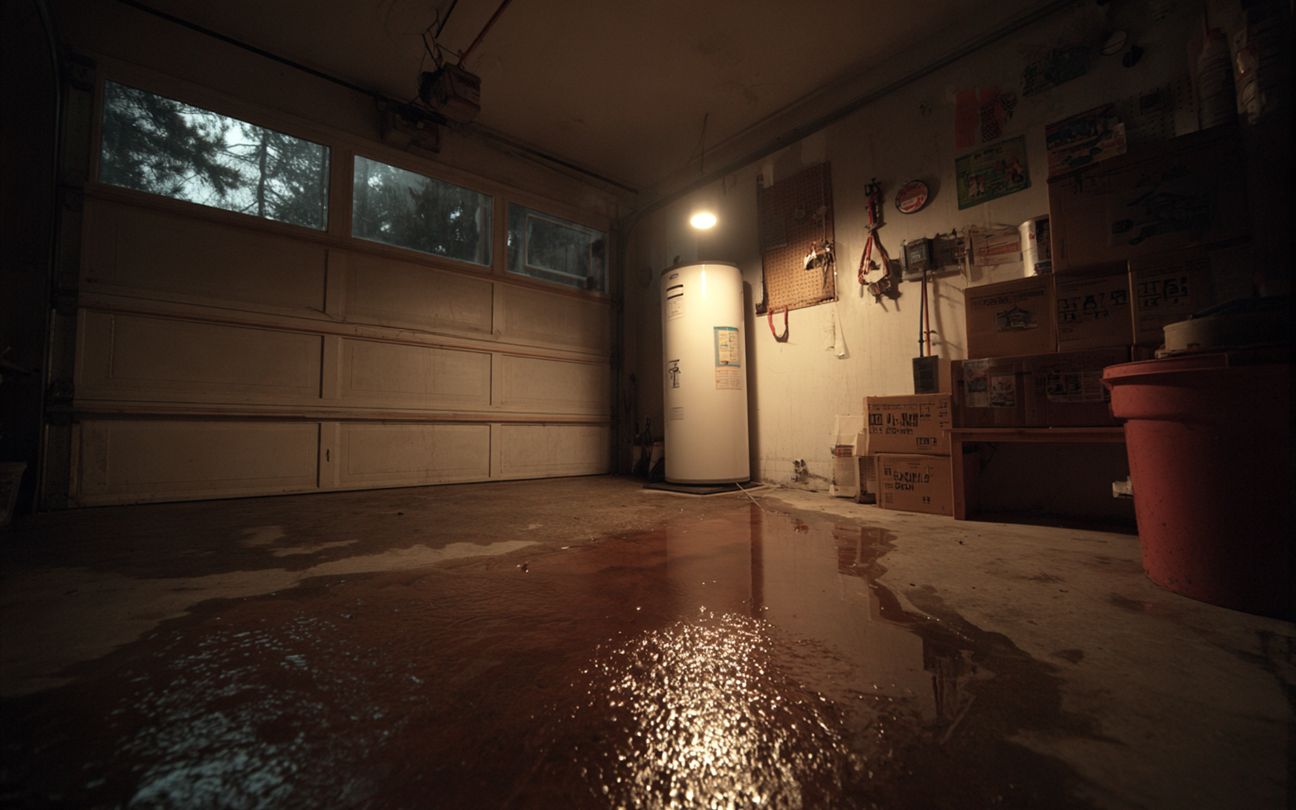
A tank water heater holds forty to fifty gallons, and when it goes, all of it goes somewhere. In older Bremerton houses the heater is often in the basement or a utility closet; in newer homes, often in the garage. Signs before failure: rust at the base, a damp ring on the floor, a drip from the relief valve's pipe, rusty hot water. When one lets go, turn off the power or the gas, close the cold-water valve on top, keep clear of hot water and pull stored things away. Replacing the heater is separate work; drying the floor, walls and what was stored nearby is the restoration side.
Washers, Dishwashers and Fridge Lines
The appliances that use water most are the ones most likely to leak. Rubber washer hoses bulge and burst with age. Dishwasher supply and drain connections loosen under the sink. Thin ice-maker lines crack or pull loose when the fridge is moved. These leaks often run under cabinets and flooring before anyone sees them. A cheap battery water alarm next to each appliance gives you a warning before the floor does.
Using the Water Meter
If you suspect a hidden leak, turn off every faucet and appliance and look at the water meter. If the dial or the small leak indicator is still moving, water is going somewhere it shouldn't. That's a good reason to call before a stain or a soft floor shows up.
Outside Faucets
A hose left on an outside faucet in a freeze traps water in the line behind the wall, where it splits. Disconnect hoses every fall, and if a faucet has frozen before, look at the wall behind it after the next cold snap.
After the Repair
Once the failed pipe or appliance is replaced and the house reads dry, keep an eye on the area for a few weeks. A stain that returns or a floor that softens again means water is still getting in somewhere, and the sooner it's caught the smaller the second job.
What If the House Was Empty When It Happened?
Expect a bigger job. A pipe that ran for days soaks more of the house, sometimes through more than one floor. Shut off the main, photograph everything, and call. More: an empty house between tenants or orders.
Is Water From a Burst Pipe Clean?
It starts clean. Once it has spread through walls, floors and a crawlspace, it picks up whatever was there, which is another reason to get it out and dried quickly.
Pipe and Appliance Calls Around the Peninsula
The Narrows and Sinclair Inlet
- Downtown BremertonSinclair Inlet
- ManetteThe Narrows
- West BremertonSinclair Inlet
- Navy Yard CitySinclair Inlet
- Port OrchardSinclair Inlet
- GorstSinclair Inlet
Dyes Inlet
- Sheridan ParkThe Narrows
- Rocky PointDyes Inlet
- Kitsap LakeDyes Inlet
- IllaheeDyes Inlet
- SilverdaleDyes Inlet
- TracytonDyes Inlet
- ChicoDyes Inlet
The Sound side: Manchester
Liberty Bay
Hood Canal
Once it's pumped out, the drying and rebuild are covered on restoration and mitigation.