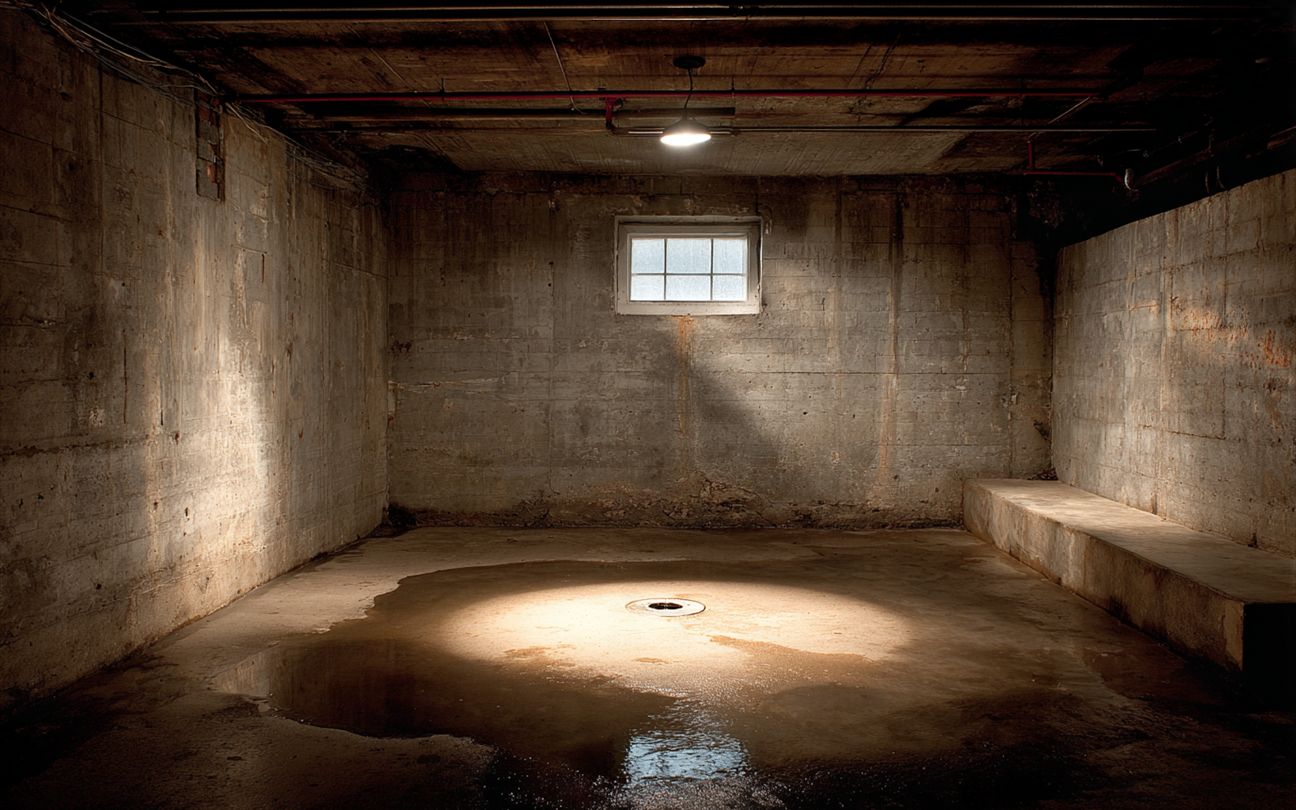
Basement Flooding and Water Removal
Bottom line: in Bremerton, basement water usually comes from the ground, and it keeps coming until the ground drains. Many of the city's older houses, in Manette, West Bremerton and the blocks around downtown, were built with full basements or daylight lower floors on sloping lots. After weeks of rain the soil around the foundation fills, and water finds the lowest openings: the joint where the wall meets the floor, cracks in the concrete, old pipe penetrations, window wells. Removing the water is step one. Drying the walls, the floor and anything finished down there is the longer part.
Where Basement Water Comes From
| Source | What it looks like | When it happens |
|---|---|---|
| The wall-floor joint | A wet strip along the base of a wall, spreading onto the floor | After long wet spells |
| Wall cracks | A damp line or trickle from a crack | During and after heavy rain |
| Window wells | Water running in at a low window, a wet sill | When the well fills faster than it drains |
| Plumbing | Water near a water heater, washer or supply line | Any time, rain or not |
| A floor drain backing up with clean water | Water rising around the drain | In heavy rain if the drain line is overwhelmed |
If water shows up only in long rains, it's almost certainly ground water. If it appears in dry weather, look at the plumbing first. More on older houses: shipyard-era houses and old plumbing.
Daylight Lower Floors on Hillside Lots
A daylight lower floor is half basement and half ground floor, and it gets wet on the buried side. Bremerton's hills mean many houses have a lower level where the uphill wall sits against the soil and the downhill side opens to the yard through a door or windows. That buried wall takes ground water; the finished family room or bedroom behind it takes the damage. Gutters overflowing onto the uphill side and downspouts emptying at the foundation make it worse. More: downspouts and yard drainage on slopes.
Pumping and Drying Below Grade
- Make it safe. Power off to outlets, appliances and the furnace if water has reached them.
- Pump the standing water toward a drain or out of the house.
- Extract carpet and pad on a finished floor; pull the pad.
- Open finished walls where meters show water behind them, usually along the bottom.
- Pull wet insulation behind finished walls.
- Dry with the space closed up: dehumidifiers and air movers running, the door at the top of the stairs shut.
- Check readings in the concrete, the framing and the remaining drywall until they meet the dry targets.
Concrete gives up water slowly, so a basement often runs equipment longer than a room upstairs.
Finished Basements: What Comes Out
In a finished basement, most of the damage is in the finishes, not the concrete. Carpet pad, the bottom of drywall, baseboard, insulation behind framed walls, and anything particleboard (cabinet bottoms, built-ins, cheap furniture) usually comes out. Solid wood furniture lifted early can often be saved. Laminate and vinyl plank over concrete need to come up so the slab can dry. Rebuild waits until the slab and the framing read dry.
What Changes the Size of a Basement Job
- Finished or unfinished. An unfinished basement is mostly pumping and drying; a finished one adds tear-out and rebuild.
- How far the water spread across the floor and up the walls.
- Whether the water is still coming, which keeps equipment running longer.
- What's stored down there and how much of it is ruined.
- Access for pumps and equipment down narrow older stairs.
Window Wells and Old Floor Drains
A window well is a small hole in the ground next to a basement window, and in a Kitsap winter it fills like a bucket. Many older Bremerton basements have wells with a gravel bottom that's long since clogged with soil and needles. When they fill faster than they drain, water reaches the bottom of the window and runs in. Signs: a wet sill, a stain running down the wall below the window, water on the floor right underneath. Clearing debris and fitting a cover helps keep it from happening again.
Old floor drains are another weak point. In heavy rain, an overwhelmed drain line can push clean storm water back up through the basement drain. If the water rising from the drain looks or smells like anything other than rain, keep clear and tell the company right away.
What's Stored Down There
Basements and lower floors are where holiday decorations, old photos, tools and paperwork end up. When water comes in, cardboard boxes wick it up from the bottom and collapse. Move what you can to a dry floor, set wet boxes aside rather than throwing them out, and photograph everything for the insurer. Paper and photos can sometimes be saved if they're separated and dried flat quickly.
Sump Pumps
Some Bremerton basements have a sump pit and pump. If yours does, test it before the wet season by pouring a bucket of water into the pit, and remember it stops when the power goes out in a windstorm.
Will the Basement Keep Leaking After It's Dried?
If the water came from the ground, it can come back in the next long wet spell unless the cause is addressed: grading, gutters and downspouts, window wells, or drainage work by other contractors. The restoration company dries what got wet and can tell you what it saw.
Is It Safe to Go Down There?
Stay on the stairs if the water touches anything plugged in and the power's live. Kill the basement circuits at the panel only if the panel is somewhere dry. Any whiff of gas means everyone out, and the gas utility gets phoned from the yard.
Basement Calls Around the Peninsula
The Narrows and Sinclair Inlet
- Downtown BremertonSinclair Inlet
- ManetteThe Narrows
- West BremertonSinclair Inlet
- Navy Yard CitySinclair Inlet
- Port OrchardSinclair Inlet
- GorstSinclair Inlet
Dyes Inlet
- Sheridan ParkThe Narrows
- Rocky PointDyes Inlet
- Kitsap LakeDyes Inlet
- IllaheeDyes Inlet
- SilverdaleDyes Inlet
- TracytonDyes Inlet
- ChicoDyes Inlet
The Sound side: Manchester
Liberty Bay
Hood Canal
No basement, but water under the house? See crawlspace vents and vapor barriers.